Today was B-Day : Barefoot Day. Martine and I have arrived at this point together, but from different routes, so we've decided to co-write this post.
Martine:
I’ve always know, somewhere at the back of my mind, that shoes are not really good for horses feet. I can’t remember where I first heard the phrase “take the shoes off to give the feet a break”, but I’ve usually done it, once a year for my own horses, for two – three months at a time. I’ve never done anything more permanent, though, because horses need shoes, right?
Over the last few years, I’ve been thinking more and more that my daughter's horse in particular didn’t need shoes – 80% of his work was in the arena, with the odd road, field or beach hack thrown in to vary his routine – but I never followed through on it. Anyone I discussed it with had the attitude “if it’s not broke, don’t fix it”, so I left well enough alone.
Then I read Joe Camp’s book Soul of a Horse. He does verge on being the crystal-swinging, incense-burning, tree-hugging-hippy horse keeper from time to time, but he makes a lot of very sensible points about why horses were shod in the first place, and how is it that wild horses somehow survive without shoes, in many cases in the most extreme rough terrains.
I know a lady locally who started on the barefoot path two years ago, and hasn’t looked back since – I’ve chatted with her on and off about the barefoot idea, but was never brave enough to do it.
I did some more research on the internet, both scientific and anecdotal, and followed the story of two Irish women who were transitioning their horses –
poniesathome and
twohorses. Theirs is not a story of an easy transition and plain sailing, but it showed me beyond doubt that it can be done, given time, knowledge and willingness to invest in hoof boots.
I resolved that on our return from France, I would finally take the plunge and Flurry would “lose the shoes” and I mentioned this to Anne.
Anne :
When we first started talking about "the Trek" I was concerned about Gigi's inability to go down hill at a decent pace. She really minds herself, and still has the odd slip and slide. Whereas Flurry marches happily off, albeit doing enormous slips and slides, but how were Gigi and I going to keep up with Martine and Flurry. Then I read "Riding the Milky Way", the story of a trek from the centre of France to Santiago de Compestela in Spain. Their reasons for going barefoot seemed so logical, and they found that the horses had much better grip without the shoes, obvious when you think about it. They used "hoof boots" some of the time, and managed the journey without resorting to shoes, although they did have problems with loosing boots.
Had we left it too late ? Could we transition our horses in time ? Well surely it was worth a try. Would I be able to convince Martine ? Well I did manage to convince Martine and we got the contact details for the "barefoot lady" from our mutual friend Frances.... as to the rest, we shall see!
Martine:
So
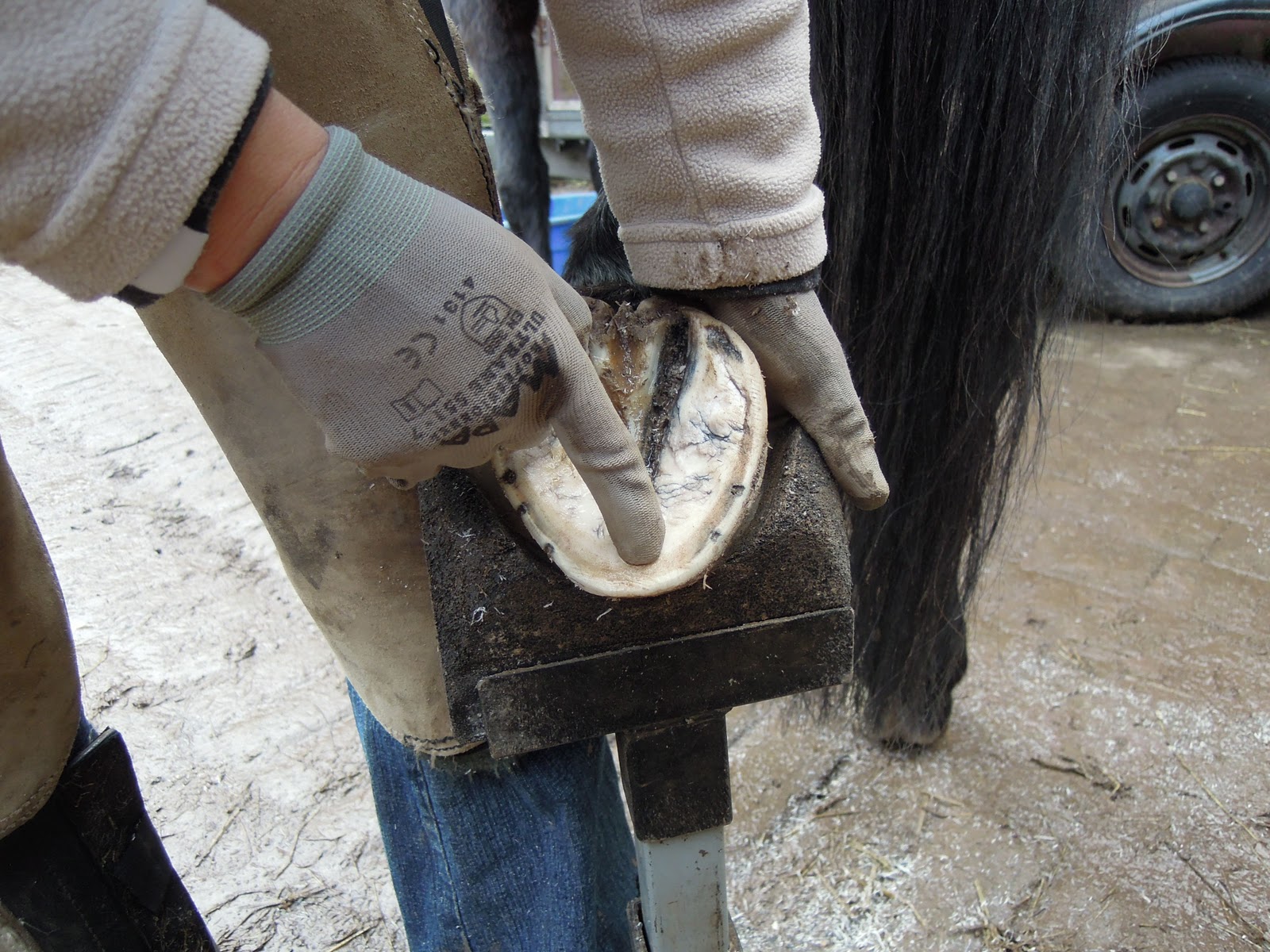
Anja Koch, Equine Podiatrist, arrived into the yard at mid-morning on November 10th.
She started on Aero, Tansy's horse. First thing to note was his very flaky, brittle feet, which my farrier had also pointed out recently. Once his shoes were off, I could see much more clearly what she was talking about. His front feet were ok, and should grow into a good barefoot shape quite easily.
 |
| Left one done, right one to do |
His back feet, though, were extremely long - years of wearing shoes and being trimmed into a shape suitable for shoes has forced the hoof capsule to grow forward, giving him a breakover point which is too far forward and causing him to flick his toes off the ground as he trots.
 |
| Very long - in fairness it's just over six weeks since his last shoeing |
 |
| Much better - the deviation is even improved |
 |
| That bulge at the front shouldn't be there |
 |
| Same foot post trim |
 |
| Anja pointing to where the toe should be |
 |
| Pointing at the same spot post trim - toes are MUCH shorter |
 |
| GiGis turn |
 |
| More brittle feet - pre trim |
 |
| Post trim - shorter and more rounded toe |
 |
| Flurry's big round front foot |
 |
| Flurry' front post trim |
 |
| Flurry's hind foot - just looks a bit long in the toe from this angle |
 |
But take a shot from the side and you can see how high the frog is
The heels will come down and the frog will recede |
Anja advised us to walk the horses in-hand in the arena for a couple of days - twenty minutes of marching around will be more beneficial than a whole day mooching around the field, as it should really get the circulation going.
She left a rasp with us, with instructions to even off any chips or rough edges that appear over the next few weeks and she’ll come back to us just before the horses leave to do another trim and tidy-up job.
We’ve made contact with an Equine Podiatrist (Beatrice Vuillaume) about an hour from Cereste who will help the horses continue to make the transition when we get there.
Both she and Anja have been very helpful and also realistic – we all agree that it will be tight to have the two horses fully transitioned within 5 months, but that it is possible. Worst case, we get them shod before we start the big trek – their feet should be good and healthy at that stage, so three to four weeks of wearing shoes won’t hurt. Best case, they manage the whole lot barefoot, and somewhere in between is the scenario where they wear hoof boots part of the time.
It will be worth so much to us if we can achieve it, in terms of safety and security while travelling over varied terrain, and in terms of not needing to worry about cast shoes and finding farriers in the middle of nowhere.
 |
Gigi and Mick
|
Anne:
Gigi had the added pleasure of a visit from the equine dentist, as horses no longer live naturally, grazing the prairies all day long, they tend to grow spurs and sharp edges on their teeth, that need to be rasped off from time to time. Gigi seems to really enjoy the visits from Mick Dillon, who has endless patience with her, doing all the necessary work without the use of sedatives.
 |
| Gigi giving Mick a good look at her teeth |
Paddock management for barefoot horses.
 |
| The first load spread |
Standing around in muck and slush all day is not good for hoofs, so we’ve had two loads of mixed stone delivered to ensure that the horses have the option of a dry hard area to stand on. There are big stones underneath, and then “blindings”, which is limestone chip and dust, spread on top.
All three horses were happily standing on it this morning, shoeless. Strangely enough, yesterday morning, GiGi was reluctant to stand on it, even though she still had her shoes at that stage.
 |
| The end result - they seem quite happy to stand on it! |
The horses have somewhere between six and eight weeks left living here – hopefully what they have in the paddock will be sufficient for their needs – a hard dryish area, a sandy area and a muddy area (which was grass once upon a time) plus regular work either in the arena or on the road as they adjust.